Temporal Self
Windows Installer Link: Release Temporal Self V01 · calluxpore/Temporal-Self
Github Repository: calluxpore/Temporal-Self

The Idea
We remember places before we remember dates. A childhood home, the café where you got bad news, the trail where an idea clicked: memory is spatial before it is chronological. Traditional journals ignore this: they sort by time, flattening experience into a feed. Temporal Self starts from the opposite premise. Every memory is a coordinate first. The map is the primary interface for recording and retrieving personal history.
But pinning a moment to a place is only half the problem. The other half is forgetting. Ebbinghaus (1885) demonstrated that new information decays rapidly, roughly half within days, unless reinforced, a finding replicated under modern conditions (Murre & Dros, 2015). Research on the spacing effect confirms that distributing reviews over increasing intervals counteracts this decay (Cepeda et al., 2006). Temporal Self layers this principle onto the map: memories become recall prompts that surface when most at risk of being lost.
The design challenge was making this feel like journaling, not studying. The tool needed to preserve reflective, narrative quality while embedding spaced-repetition mechanics invisibly so remembering feels like revisiting a place, not drilling a fact.
Memory as Material
Each memory is a layered object: title, date, photograph, voice recording, mood (five levels), a "sense of place" descriptor, markdown notes, tags, links, and a custom label. This density is intentional. Craik and Lockhart's (1972) levels-of-processing framework showed that deeper, multi-sensory encoding produces stronger memory traces. The interface encourages this by offering many optional channels without mandating any; each added layer deepens encoding.
Photos are first-class material. Dropping a photo reads its EXIF data to extract GPS and date, auto-placing the memory. Photos without geotags land in an ungeotagged tray for manual placement: an interaction that itself reinforces the spatial association. Optional AI integration (Gemini, OpenAI, or Claude) can auto-analyze queued photos, surfacing unnoticed details.
Voice notes add temporal texture text cannot: tone, hesitation, and background sound. Mood tracking feeds a dedicated statistics view, turning emotional patterns into visible data.

The Map as Narrative Surface
The map is not a container for pins: it is a narrative surface where spatial relationships carry meaning. Two clusters of pins near a campus and a hospital tell a story no chronological list could. Distance, density, and the timeline path connecting them are spatial narratives that emerge without being authored.
Timeline paths draw polylines connecting memories in sequence, with spline (curved) or orthogonal (right-angled) styles. Splines suggest flow and journey; orthogonal paths suggest structure and decision. Radius circles (~2 km) show each memory's "reach"; overlapping circles merge into unified outlines, revealing areas of memory density.
Groups organize memories into named collections (a trip, a project, a relationship), each with its own timeline path. The calendar view stacks three months with dots on days holding memories. Switching between map, list, and calendar gives three readings of the same archive.

Recall: Turning the Map into Memory Palace
The central proposition: a map of your own memories, visited at spaced intervals, functions as a personal memory palace. The Method of Loci, associating information with spatial locations and mentally traversing them, is among the most effective mnemonic techniques known. Ondřej et al. (2025) found a large effect size on recall (d = 0.88) compared to rehearsal. Dresler et al. (2017) showed that six weeks of Method of Loci training reshaped brain connectivity to resemble world-class memory athletes, with improvements persisting months later.
Temporal Self literalizes this: locations are real places, associations are lived experiences, and the walk is performed on the map. Two recall modes make it concrete.
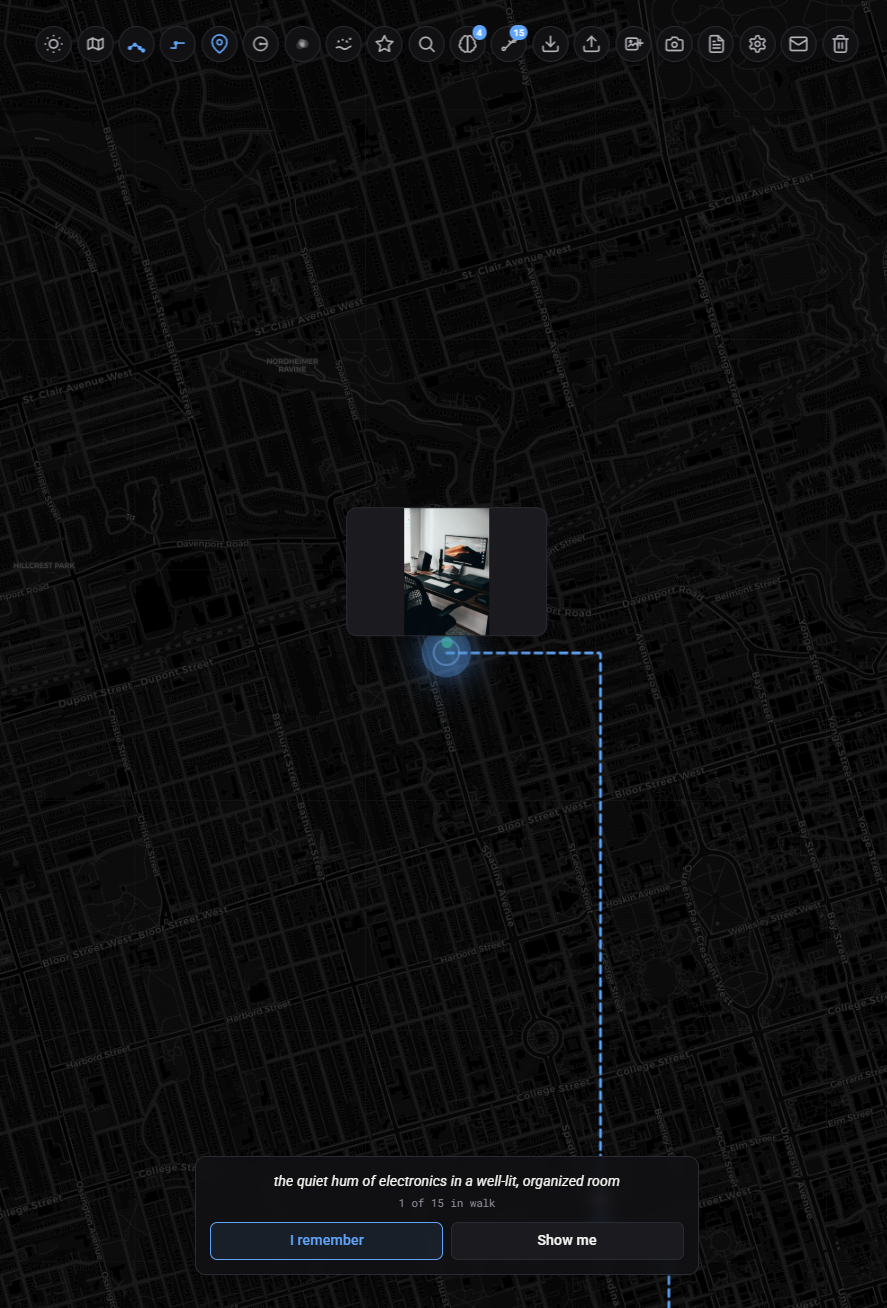
Flashcard mode presents memories as cards in a side panel while the map flies to each location. Three responses: "I remember" (SM-2 extends the interval), "Show me" (interval resets, full memory opens), and "Skip." Due items surface first, prioritized by fragility. Keyboard shortcuts (1, 2, 3) keep the rhythm fast.
Spatial walk mode is slower and closer to the Method of Loci. The map flies to each memory at wider zoom, presenting only a place cue: the "sense of place" descriptor, a geocoded label, or coordinates. A floating clue card shows the photo near the marker. The user recalls before tapping "Show me," which reveals the full memory on the map. This turns the map into a walkable, cued environment, not a quiz, but a place to wander and remember.
Both modes feed into recall statistics that make the forgetting curve and the user's progress visible.

Privacy and Ownership as Design Values
Temporal Self has no accounts, no cloud, and no backend. All data lives in IndexedDB or on the filesystem via optional vault sync. This is a design position, not a limitation. A tool holding your memories, moods, voice, and locations is too intimate for a server.
The vault writes memories as Markdown with YAML front matter into a user-chosen folder, human-readable, searchable, and compatible with tools like Obsidian. If Temporal Self disappears, the data remains useful.

Research Instrument
An optional study workflow transforms the tool into a research instrument. Inside Memory Stats, a researcher enters a participant ID, selects a checkpoint (Baseline, 2 Days, 2 Weeks, 40 Days), and marks sessions complete. An append-only event log records timestamped actions without interrupting use. JSON export includes all study fields for external analysis.
This was not an afterthought. A local-first memory tool with SM-2 scheduling and timestamped logs is, almost by accident, a ready-made instrument for studying human memory. The tool and the study apparatus share the same data.

Reflection
Temporal Self sits at the intersection of three ideas: memory is spatial, forgetting follows predictable counteractable patterns, and personal data should remain personal. The core design tension was between spaced repetition's efficiency and journaling's reflective quality. The two recall modes resolve this: flashcards are fast; spatial walks are slow and exploratory.
The project also revealed how much narrative emerges from spatial data without being designed in. Timeline paths, mood heatmaps, radius overlaps, and calendar dots: each reads the same archive differently, telling stories the others cannot.
What Worked
- Place as recall cue: Showing a place cue before the memory forces effortful recall; users re-enter a context, not just retrieve information.
- Narrative emergence: Timeline paths and mood heatmaps make the shape of a life visible without explicit narration.
- Layered capture: Many optional channels (photo, voice, mood, sense of place, markdown, tags, emoji) let users encode as richly or lightly as the moment calls for (Craik & Lockhart, 1972).
- Vault as open format: Markdown with YAML front matter means memories outlive the application.
- Research-ready by design: The event log and checkpoint tracking required minimal interface but made the tool usable for longitudinal studies.
What Did Not Work / Limitations
- No empirical validation yet: The SM-2 system is implemented, but no controlled study has measured whether spatially anchored recall improves retention over conventional methods.
- Screen-bound spatial walk: The metaphor works on a map but remains screen-mediated. Extending into AR (as Mind Palace XR explored) would make "walking through memories" literal.
- Cross-device sync: Local-first means no native sync. The vault partially addresses this via synced folders, but it is not seamless.
- Emotional dimension underexplored: The mood heatmap surfaces patterns but doesn't yet prompt reflection on them.
- AI integration tension: Optional AI analysis requires an API key and internet, sitting uncomfortably with local-first philosophy.
References
Cepeda, N. J., Pashler, H., Vul, E., Wixted, J. T., & Rohrer, D. (2006). Distributed practice in verbal recall tasks: A review and quantitative synthesis. Psychological Bulletin, 132(3), 354–380. https://doi.org/10.1037/0033-2909.132.3.354
Craik, F. I. M., & Lockhart, R. S. (1972). Levels of processing: A framework for memory research. Journal of Verbal Learning and Verbal Behavior, 11(6), 671–684. https://doi.org/10.1016/S0022-5371(72)80001-X
Dresler, M., Shirer, W. R., Konrad, B. N., Müller, N. C. J., Wagner, I. C., Fernández, G., Czisch, M., & Greicius, M. D. (2017). Mnemonic training reshapes brain networks to support superior memory. Neuron, 93(5), 1227–1235.e6. https://doi.org/10.1016/j.neuron.2017.02.003
Ebbinghaus, H. (1885). Über das Gedächtnis: Untersuchungen zur experimentellen Psychologie [Memory: A contribution to experimental psychology]. Duncker & Humblot.
Murre, J. M. J., & Dros, J. (2015). Replication and analysis of Ebbinghaus' forgetting curve. PLOS ONE, 10(7), e0120644. https://doi.org/10.1371/journal.pone.0120644
Ondřej, V., et al. (2025). The method of loci in the context of psychological research: A systematic review and meta-analysis. British Journal of Psychology. https://doi.org/10.1111/bjop.12799